|
Projection screens - information and purchase advice
Welcome to our detailed websites about projection screen, projectors and beamers! Those who want to have a small cinema at home, enjoy some films and images in the living room by means of a beamer or arrange a small conference room with a modern technique of presentation will find some detailed information on this page for the choice of the suitable projection screen.
On the following websites, we do not only guide you step by step to the best suitable screen for you but also provide you with some detailed technical and specialized information all around the topic of the projection screens, presentation and projection. In the following text we present a short index of each of our pages concerning this topic:
Index
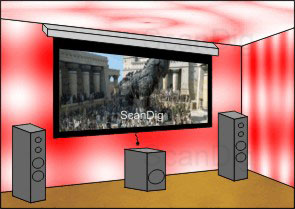
On this website, the buyer of a projection screen is guided step by step to the most suitable projection screen. Each of the steps that should be considered for the decision making are shortly explained in a way that it is easy to understand, so that also an amateur will easily find the necessary information for the choice of the right screen. In our screen purchase advice, each of the following steps are followed one by one: 1. Step: Type of projection, 2. Step: Screen model constructionl, 3. Step: Projection screen masking, 4. Step: Type of projection screen, cloth type and gain-factor, 5. Step: Image format, aspect ratio, 6. Step: Size of the projection screen
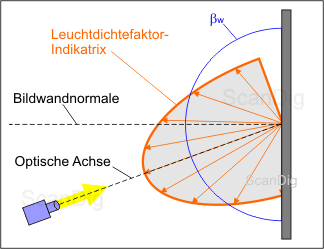
This chapter provides a detailed overview of the different types of screens available according to the DIN standard. Each type of screen is described in detail and a graph illustrates each of the respective light-reflection behaviour. Each of the following screen types are described: Diffuse screens with consistent, diffuse reflexion behaviour (screen type D), pearl screens and crystal screens with a preference direction of the reflexion behaviour (screen type B), metal screens and silver screens, which reflect the incoming light (screen type S), and back projection screens, which do not reflect the incoming light but transmit it (screen type R).
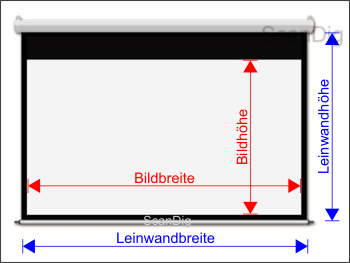
This website provides a detailed overview of the possible screen formats and projection formats. At the beginning you will learn the basics about different screen formats (1:1, 4:3 or 16:9) and image formats (1:1 full format, 4:3 television format and 16:9 cinema format). There are numerous pictures illustrating how, for example, a slide, a computer image, a normal TV image or a movie with a determined projection size is represented on the screen. We investigate in detail the cooperation of different screen formats with different projection formats, e.g. how the image of a modern 16:9 beamer will be displayed on a 4:3 screen.
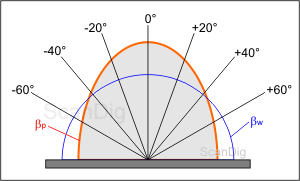
If you buy a screen for the private or professional use, you will encounter again and again the light density factor in data sheets and prospects. The light density factor is also called gain factor. This important parameter is used ad a kind of performance feature at different screens, as for example the processor speed or the image size of the hard drive is used as the performance feature of a computer. We will explain in detail, how the light density factor is defined, derive it from other physical parameters, and show you, how to interpret the value of the gain factor and what to learn from the gain factor concerning the reflexion behaviour of a screen.
|
|


 Screen selection