Light panels - information and purchase tips
Anyone working with film material of any kind (mounted slides, medium format filmstrips, X-ray photographs) frequently or on a regular basis cannot avoid using stationary or moble light panels. As a private person might hold a mounted slide in direction of a window every now and then to be able to recognize the motive or its orientation, semi-professional or professional photographers as well as, of course, photography agencies use large light panels e.g. to choose a correctly exposed picture from a bracketed series. Radiological surgeries could not be imagined without their large, wallmounted light panels.
All light panels shown on this site are available in our online shop. The advantages are obvious: one looks at a positive that is brightly lighted by an even light source without this being blinding. Though many private persons never thought of buying a light panel in the whole time they were collecting slides, this becomes a matter of interest as soon as one is beginning to scan in large amounts of slides. Of course, there is the possibility to scan in all existing slides and to make one's choice on the computer screen. Anyone, however, who has no expensive magazine scanner at hand and thus has to scan in one picture after the other separately will be able to save a lot of time and work by pre-selecting using a light panel.
And then, there are people who absolutely want to avoid buying a slide scanner and thus take pictures of their slides using a very good digital camera. The individual slides have, of course, to be placed on a small light panel to be lighted at all.
General information on the term "light panel"
First, we will define which sort of light panels will be discussed here, as the term "light panel" is used in many contexts today: special equipment for viewing radiographs, for the examination of bank notes or for the irradiation of gel substances, and panels with ultraviolet lamps are all often referred to as light panels. On this page, we talk about light panels for photographers, i.e. for the viewing of positive films and single images.
On the term "light panel": light panels exist for a long time already, although calling them "panels" would have been inappropriate some decades ago. One talked of light boxes or light tables instead. Some of you might still have an old light box in the cellar or on the desk. The term "box" rather describes the construction: they are heavy, big devices with a large frame and a nothing less than even light distribution.
Modern light panels as are discussed here are indeed compact, slim panels with thin frames and an even light distribution. The smallest of them have a thickness of just 1cm and can thus easily be moved or stowed away. Even huge light panels with a width of over half a metre are only a few centimetres thick and therefore not at all monstrous. Strong handles as were necessary to carry a light box in the past can hardly be found on the slim panels any more today
Important criteria when buying a light panel
Speaking casually, purchasing a light panel is quite a simple thing: the article has to be illuminated and of a certain size according to its use. As soon as you actually work with a light panel, you will find out that a whole number of factors plays an important role. In the following, some important criteria that have to be considered before buying a light panel are explained more thoroughly.
Size and design
Light panels exist in most different sizes and designs, beginning with mobile, battery-operated miniature panels and ending with large desktop light boxes. First of all, one should of course think of the necessary size and the purpose. Someone who only wishes to view one slide or the other every now and then can be recommended a battery-operated miniature light panel with an illuminated surface of e.g. 10 x 10 cm. Such a tiny article can be easily stowed away and is ready to use without extensive wiring.
If you are more interested in using your light panel for the sorting or the selection of images, you will have to take a larger desktop light panel. Such panels with an external power supply exist in sizes from a small 15 x 20 cm format up to dimensions that exceed 30 cm in height and half a metre in width. But why do many large light panels have a height of the illuminated area of 30 cm? It's because of the height of an A4 sheet (approximately equivalent to letter format): many photographers or agencies use A4-size sheet protectors to range mounted slides or medium format strips. To select individual images from such sheet protectors, one simply places the complete sheet protector on the light panel and thus avoids the laborious taking out of the respective positives or the unnerving permanent moving of the sheet protector on the surface.
An important thing to consider when choosing the size is the difference of the light panel's size and the size of the illuminated area. Modern, stylish light panels only have a narrow frame around the illuminated area itself. Therefore, the size of the illuminated area is the decisive factor when purchasing a light panel. While choosing the width and height of a light panel rather depends on its use, the thickness is a question of its look. Modern light panels have a thickness of between one and three centimetres and therefore look elegant and up-to-date. An - in respects of its thickness - clumsy light panel does not look good any more on desks where free space becomes more and more limited anyway.
Design and positioning options may also play an important role for some buyers. While you just place a miniature light panel on the desktop like a piece of board, a larger panel should be equipped with supporting legs or brackets to allow comfortable work (comparable to a computer keyboard). It is not comfortable to work with a panel of a height of 30 to 40 cm that is lying on the desk like piece of board as you can only view the positives in the top rows under a certain angle.
Some light panels can also be mounted on the wall, which of course only makes sense when suitable fixation bars or other fixation devices are included (as can be seen at the typical wall-mounted light panels surgeons use for radiographs). And then, there are light panels that can, using special mounting kits, integrated into existing worktops or a desk. This, however, already takes us into the field of professional laboratories or agencies.
Light source, light distribution and colour temperature
A light panel has to be illuminated, this is quite clear. But anyone who has already concerned himself with topics as colour management or colour temperature knows that there are differences in light. Light resp. light conditions are described by a certain colour temperature, and, to put it short: a light panel should produce light that is similar to daylight and with a colour temperature of about 5.000 K. In the end, it is no good ranging images using a light panel producing evening crepuscular light or the light of a halogene lamp if you intend to view the pictures in daylight later on. The colours of a slide are only reproduced correctly using standardized light.
Of at least the same importance as the colour temperature of the produced light is the light distribution onto the illuminated area. Although light distribution was rather uneven in former times, making it almost impossible to use the light panels' corners, it is today possible to illuminate the whole viewing area evenly using special techniques of light conduction and reflection while preserving a slim design.
The light source should be a cold cathode flourescent lamp that, on the one hand, produces a light temperature of between 5000 and 6000 Kelvin and, on the other hand, does not heat up. A light panel that heats up much during permanent use of course transmits heat to the film material that will consequently curl up or bend, which makes it impossible to view it without further equipment. Nowadays the LED technology is used in many light panels. So many models are available with modern LED lamps. LEDs have the great advantage of clear white light, which leads to better colours. Furthermore, they save a lot of energy. However, the price of LEDs is ususally higher than the price of normal lamps.
The lamps should, additionally, be of high endurability: the standard is between 5.000 and 10.000 hours, which means that the lamps should last the whole light panel's lifetime when used by private persons.
Features
Apart from the geometric characteristics, the power supply is the most important feature of a light panel. Small light panels can be operated by batteries as well as by an external power supply. For larger light panels, only mains operation is still worth considering. However, I would not want to miss a small, mobile light panel in my working environment any more. It is just comfortable to have a ready-to-use light panel at hand that you also can take along on a short trip.
I already mentioned the important feature of lifting larger light panels by the means of legs or brackets into a comfortable working position. As soon as the light panel is set to a certain angle or even mounted to a wall, however, it is indispensible to have fixation bars into which film strips or single images can easily be inserted to prevent them from slipping.
Anyone who does not only want to view single images or small parts of film but whole strips of 35mm or medium format will be pleased to find fixation bars on the panel's sides that hold the film; without them, proper fixation of the film on the light panel is almost impossible.
Although it is daily business for battery-operated miniature light panels to transport them, larger light boxes mainly are intended for stationary use; however, even those have to be moved at certain times. Some of the larger types are equipped with a handle on their upper side; ultra-flat light panels sometimes are delivered with protective bags or cases.
Light panel reflecta L130
The smallest light panel I know of is reflecta's L130; its measurements are 158 x 150 x 14 mm at a weight of only 260 grams. The illuminated area itself has a size of 12.7 by 10 centimetres, its surface thus being 130 square centimetres leading to the designation L130. The light panel offers space for four mounted 35mm slides or two medium format slides in 6x6 cm size. This ultra-slim light panel surely is not appropriate for making a choice from a large collection of slides or for the selection of the optimal exposure from bracketed series; one would have to move the slides too often.
The light panel Reflecta L130 LED has been taken from the market in 2016.
I always have this small light panel at hand near my desk for immediate use when I e.g. want to have a closer look at a slide , if I am not 100% satisfied with a scan or somehow mistrust the colours to be seen on the computer screen after scanning, or to see in which direction the slide has to be inserted into the scanner. Further more, this miniature light panel is ideal to take along to meetings with customers or friends in your office, at home or during business trips.
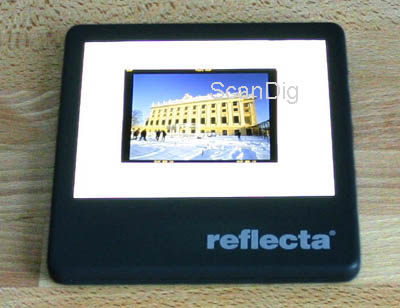
The L130 light panel operates on 6 AAA-type rechargeable batteries, which allows easy operation in any place. Of course, it also comes in handy when preparing classic slide shows for the changing or turning of slides. The energy consumption of 4.5 Watts results in an operation time of about 10 hours, using special batteries, before they have to be recharged.
For permanent use, there is an optional 9V power supply. An ideal combination is using batteries along with the power supply; thus, the light panel does not consume the batteries when being stationary, but can easily separated from the mains plug and taken away. For transport, delivery of the light panel includes a securely fitting leather pouch.
This miniature light panel's light conditions are very good, the whole illuminated area can be used. Thanks to the LED technology there is a uniform light distribution, and you don't have to worry about changing the lamp.
Because of its small dimensions, its low weight and the good portability (due to battery operation), I can only recommend this miniature light panel.
Dörr light panel LT-2020 LED (illuminated area of 16.5 x 16.5 cm)
The Dörr light table LT-2020 comes in ultra flat design and is continuously dimmeable. At only 315 grams, it measures 20 x 20 x 0.8 centimeters on the outside. It's all white and the border around the illuminated area of 16.5 x 16.5 centimeters measures 3.5 centimeters in width.
The mains adaptor (AC100-240V~ 50/60Hz DC12V 2A) comes in all white, too, providing energy to the light table. Since battery operation is not an option, the light table needs to be plugged in at all times during operation. The mains plug is a micro usb port. It is clearly labeled not to be used with cell phones or tablets.
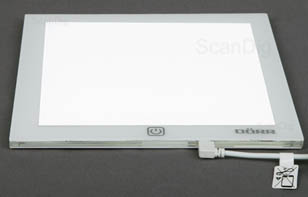
In the scope of delivery, you will also find a black slipcover with a drawcord. This will protect the high quality acrylic surface during transport and storage. Between the acrylic plates, a total of 36 LEDs are working, with a total of 7.2 watts. The manufacturer specifies both color rendering index and color temperature. The color rendering index CRI is > 90 and the color temperature is 5600K. To evaluate slides in terms of color, one typically needs daylight, which is 5000K.
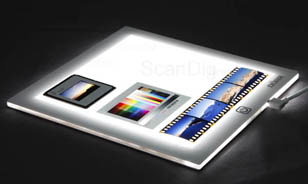
Via the on-off switch located in the middle of the light table, the device can be steplessly dimmed, depending on the purpose. According to the manufacturer, the light table is suitable not only for viewing slides and negatives, drawing and tracing, but also as a background light source for paper prints.
The lit area of 16.5 x 16.5 centimeters provides enough space to fit 4 35mm film strips with a length of 4 images each. Alternatively, 9 framed slides fit on the surface. Depending on the size of the material, only 2-6 medium format images can be placed on the lit area.
Light table Reflecta A5 LED 19 x 14 cm
In the spring of 2017, Reflecta extended its series of light tables and introduced the model A5 LED. This designation says it all about the approximate size of the light table.
The ultra slim light table measures 23.9 x 18.9 centimeters, with a thickness of just 8 millimeters. And yet the actual casing takes up a mere two centimeters all round, the rest is illuminated. The illuminated area has the measurements of 19 x 14 centimeters and thus approximately matches the DIN A5 format. Hence the label A5 LED.
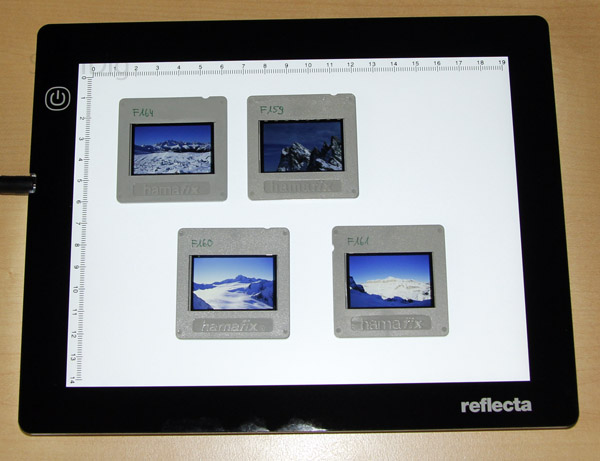
Thanks to the slim edge and the thickness of only just 8 millimeters, this light table offers a very fashionable design and thus inserts well into the modern work environment. The occasional glance at this jewel of a light table resting on your table will make you feel very pleased. With a weight no more than 400g, it is an absolute featherweight. It is self-evident that such a thin light table can be realized only using LED lighting engineering. Also, it is obvious that such a thin light table cannot house batteries. The light table Reflecta A5 LED functions only with the enclosed mains adapter. The power consumption is very low at 4.3 watts, even continuous operation will not arise considerable electricity costs.
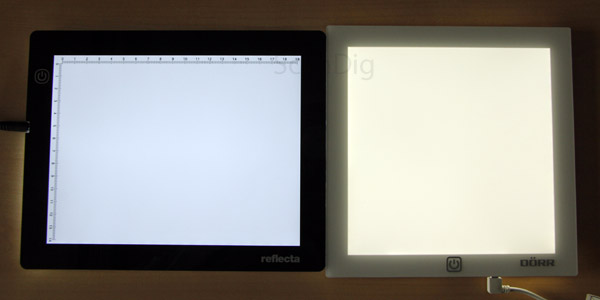
The light table is powered up via a small switch, which resides on the left side above the power connection. Using this switch, the light table can also be dimmed. If you rest your finger on the switch, the brightness will increase until the maximum brightness is reached, and then decrease again. The brightness of the light table is more than sufficient at its peak and will commonly be lowered a few instances for every day use. Looking at the lit area, you will quickly notice a strong blue tint, independent from the level of brightness used. Place a Reflecta A5 LED directly next to a Dörr LT-2020, and you will realize the extreme difference in color temperature.
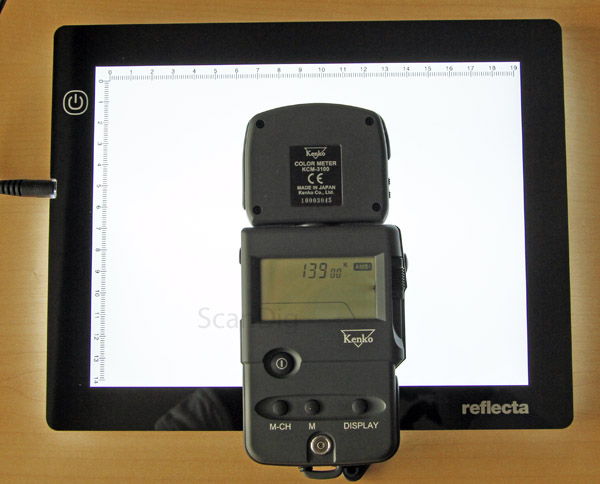
Since Reflecta does not state a color temperature, we measured it using a colorimeter. The measurement yields a value of 13900 K. Whilst common household led bulbs range at a temperature of 2500 K to 3500 K, it was quite a new experience to see an LED light of 10000 K. Since for fotographic material, light sources in the range of 5000 K are used, the light table Reflecta A5 is absolutely unsuitable for this purpose.
In order to identify the theme, this light table will serve well. For judging colors, it doesn't. That's a shame, because it is a very nifty, compact device.
Light panel reflecta L600 LED
The light panel Reflecta L600 LED has been taken from the market in 2016.
The ultra-slim light panel L600 LED by reflecta has overall dimensions of 370 x 275 x 25mm and almost exactly a weight of 2 kgs. The size of the illuminated area is 30 x 20 cm, equivalent to 600 square cm - therefore the designation L600. This surface corresponds nearly exactly to an A4 sheet, thus one can put a sheet protector for slides on it in whole.
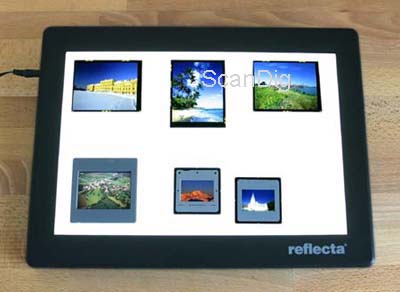
This already points out an essential advantage of this light panel: many photographers range their mounted 35mm slides, film strips or single medium format images in DIN A4-size (i.e. 29,7 x 21,0 cm) special sheet protectors. Thus, to select images from such a sheet protector, one does not have to extract one image after the other from it for viewing - you just place the whole sheet protector on the illuminated area and get an instant overview. This saves an enormous amount of time during image selection. Due to its compact dimensions, the L600 light panel does not occupy much space on your working table. With its appealing design and its low thickness of only 25mm, it also easily integrates into a modern working environment. Given a power consumption of 19 Watts, only mains operation (no battery operation) is possible.
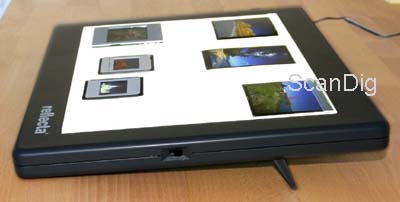
Modern LED lamps are used as light sources. The life time of the LEDs is about 10.000 hours according to the manufacturer, so that they should usually work for a light panel's life time. Thanks to the low heat emission of the LED lamps there is no significant warming of the glass plate nitoceable. This also is an important requirement for permanent use as a heated light panel would transmit its temperature to the film material, which would then curl or roll up. The LED lamps light the whole illuminated area evenly, making the complete 30 x 20 cm surface utilizable for slide viewing.
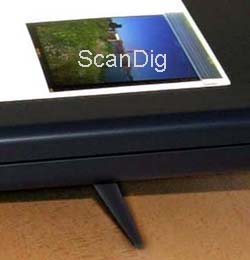
I only learned about three important features when unpacking the light panel: on its lower side, there are two small feet that make it possible to set the light panel to an angle like a computer keyboard. This is helpful when working, as the viewing angle to the eye becomes more natural. It is obvious that mounted slides or single positives that are placed on a sloping, smooth glass panel are likely to slip. To avoid this, the light panel has a fixation bar on its upper edge where film strips or single images can be inserted and thus be held in position. On the bottom side, there is a small edge on which mounted slides or single positives can be laid to prevent them from slipping down. The fixation bar on the top and the edge on the bottom really facilitate work with this light panel.
Although this medium-size light panel is mainly convenient for stationary use on a desk, it can easily be transported: included in delivery as a standard item is a matching leather case with handles, in which the light panel can be securely stowed away or carried. The mains adaptor, however, has to be packed separately.
Reflecta LED light panel A4 (Luminous field 31 x 21 cm)
In summer 2016 Reflecta has introduced the LED light panel A4 to the market. If you compare it to the L600, where we say it is ultra flat, then this deserves to be called mega-ultra flat. With this light panel they have changed the construction method to make it 8mm thin. Thanks to the new construction method of the Reflecta LED light panel A4, it has this new stylish design. It fits perfectly in a modern working environment. Due to its thin design there is no place for batteries so it only works with a power supply. Not only is it thin but with only 900g, it is a lightweight compared to the other light panels.
With its new design the Reflecta LED light panel A4 can also be used to sort or even look at slides or any other transmitted light material. The illuminated area is 22,2 x 31,5cm. You have enough space on the light panel for a slide sheet. Between the black border and the light panel on two sides you have mesurements printed. The surface is flat so there are no slots to clamp somthing on it. You can change the light strength of the panel with the power button. By pressing the power button quickly it turns the light panel on and the brightness goes to the maximum. To change the brightness of the panel you just need to put your finger on the power button and hold your fingur on it, until you reach the brightness you wish. With that we have reached the main part of the light panel, the light.
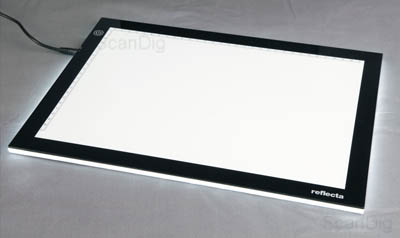
The brightness is important, but so does the color temperature especially if one want to rate the colors of the slides. Even with a low power rating of 8 Watt you won't be left in the dark. Even with the strong brightness of the LEDs. The light panel doesn´t use a lot of power and with the brightness changer everyone can find the brightness they need. The manufacturer has not given us any color temperature specifications for the Reflecta LED light panel A4. That´s why we can only compare it by viewing it with a LED light panel that we already know. The color tempreatur of the L600 is 5000K +/- 270K, so we will use it as our comparison. The light of the Reflecta LED light panel A4 in comparison has more of a blueish color which means the colour tempeature is higher then 5000K. In order to get the real value of the colour temperature we have measured the colour temperature with a colorimeter. The measuring instrument showed a colour temperatur of 12.5000 K. To evaluate the colors of a slide this light panel is not suitable. Though it is suitable for sorting and looking at them.
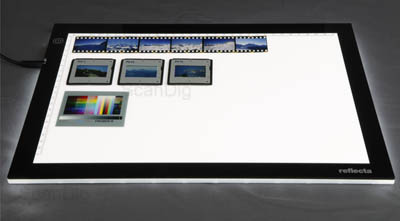
This super thin light panel differentiates itself from the other light panels with its design. Not only does it look classy when it´s off but also looks very classy when it is turned on. The on and off function as well as the brightness changer work contemporary with the touch function, with out a rotary switch. The Reflecta LED light panel A4 is a good job enrichment to look and sort slides, x-rays and more. For a color analysis we recommend a light panel with a color temperature up to 5000K.
The light panel A4 turned out to be quite unusable for photographers due to its too high colour temperatur of more than 12.000 K. A bit more than a year after market release the manufacturer brought the successor model Light Panel A4+ with adjustable colour temperature onto the market.
Reflecta LED light panel A4+ (luminous field 31 x 21 cm)
By the end of 2017 reflecta complemented its light panel portfolio by the new led light panel A4+. Compared to the existing model light panel A4 it differs by a plus symbol in its name. So let us have a look at the technical data in order to find out the exact difference between these two light panels. The size of the luminous field is 210 x 310mm at both models. However, there is a small difference at the exteriour dimensions, since the plus-variant is with its dimensions 37,1cm x 27,8cm x 0,8cm 10mm larger and 8mm longer. The weight of the A4 plus is a bit lower, with its only 640g it is really an absolute light weight. According to its description it is even super lightweight.
The Reflecta LED light panel A4+ is not available any more.
But these 30% reduction in weight and the minimal change in size don't make the Plus of this light panel. We find the reason for the Plus in the illumination. Both light panels are adjustable in their brightness, however, the Reflecta LED light panel A4+ has additionally an adjustable colour temperature. Thus a Plus in terms of Colour temperature is offered at this light panel. The usual 5000K which are feeled as day light are supplemented by a warmer colour temperature of 3000K and a cooler colour temperature of about 8000K.
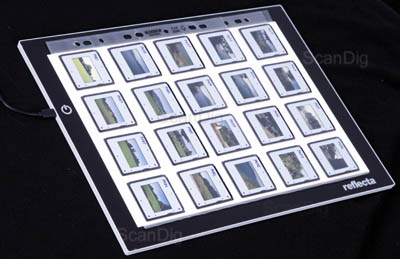
What is an adjustable colour temperature good for if the day light is considered as 5600 K, which should be used for looking at photos? One reason might be that you often don't have the chance to have day light at home. In the evening your home office might be illuminated by comfortable halogen lamps producing only 3000K, or your new working desk lamp uses LEDs which produce cool light of 8000K. On a foggy day the colour temperature of the ambient light may change significantly. With the feature of an adjustable colour temperature you can fairly adjust the light panel to different working conditions. So you make something like a white balance for your own eyes.
The Reflecta LED light panel A4+ has only one switch with touch function. By touching it once you switch on the light panel. By touching again shortly you can change between the 3 steps of colour temperature and switch off the light panel If you touch that button longer you dim the light panel in its brightness. For each of the 3 colour temprature the brightness can be set individually, the setting is beeing kept even if you switch it off. The settings are lost when you unplag the light panel from the power net. This means, that the touch swithc does not really switch off the light panel, it leads to a kind of stand-by mode only. So it becomes clear that in the manual it is recommended to unplag the light panel for switching it off if you don't work with it. At this point we want to mention that the light panel has a Micro USB interface, at which a USB power plug is used to provide it with current (AC100-240V~ 50/60Hz DC12V 0.3A).
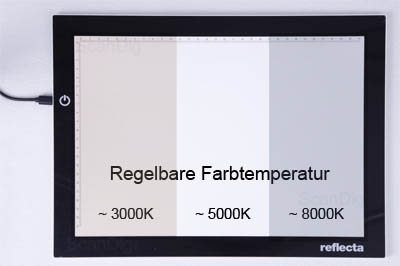
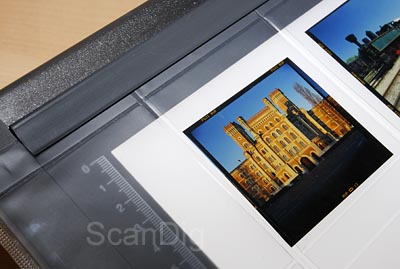
The indirect illumination at the edges of the light panel has be omitted. The light panel consists of a white plastic case in which the plexiglas plate is integrated. On the back side there are 4 small white rubber feet which provide a save and stand. On the light panel there is a scale like a ruler on two sides below the black edge. The surface of the light panel is flat, i.e. there are no grooves or installations to fix a film. The Reflecta light panel A4+ makes a simple, usable impression. It reminds at an over dimensional tablet.
The adjustable colour temperature probably will be used by hardly any buyer. Normally one adjusts the colour temperature to the middle step if you look at slides or negatives on the light panel. While the predecessor model A4 had a pretty unusable colour temperature of more than 12000 K, the new light panel A4+ has a good setting in the middle field for the photographic area.
Dörr light panel LT-3838 LED (illuminated area of 34 x 34 cm)
The Dörr light panel LT-3838 LED is stepless dimmable and comes in ultra-flat design. Despite overall dimensions of 38 x 38 x 0,8 cm, the light table weighs only 1125g. It comes in all white color, with a 4 cm rim, hence the 34 x 34 cm light area.
The mains adaptor (AC100-240V~ 50/60Hz DC12V 2A) comes in all white, too, providing energy to the light table. Battery operation is not an option. The mains plug is a micro usb port. It is clearly labeled not to be used with cell phones or tablets.
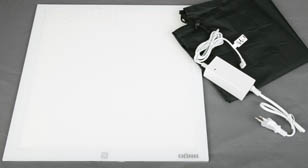
In the scope of delivery, you will also find a black slipcover with a drawcord. This will protect the high quality acrylic surface during transport and storage. Between the acrylic plates, a total of 72 LEDs are working with a 0,2 watts each, adding up to a total of 14,4 watts. The manufacturer specifies both color rendering index and color temperature. The color rendering index CRI is > 90 and the color temperature is 5600K. To evaluate slides in terms of color, one typically needs daylight, which is 5000K.
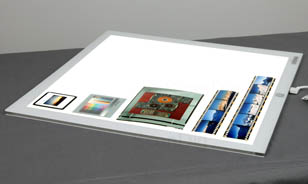
Via the on-off switch located in the middle of the light table, the device can be steplessly dimmed, depending on the purpose. According to the manufacturer, the light table is suitable not only for viewing slides and negatives, drawing and tracing, but also as a background light source for paper prints.
Thanks to the size of 34 x 34 centimeters, the illuminated area provides lots of space for film material of various sizes. May it be 35mm format, medium format or large format, everything will fit on the lit area of 1156 cm² size. Even entire slide cassettes or filing sheets.
Reflecta LED light table A3 dimmable (indicator field 44x29 cm)
As its name implies, the Reflecta light table A3 is a light table with the approximate size of DIN A3. The light table measures 48.9 x 33.9 x 0.8 centimeters, with the actual light field measuring 44 x 29 centimeters.
With a thickness of just 8 millimeters, this light table can be considered as super thin. A light table of this size can barely be thinner; otherwise it might break if held only on one side. Because of the low thickness, the reflecta A3 light table comes off as very precious. At a weight of 1600 grams, it is also very light.
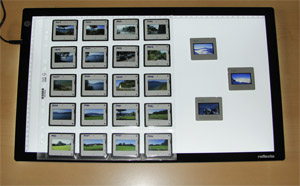
LEDs serve as a light source for this light table. They are swiched on via the switch on the left side. A brief push of the button turns the light table on and off; a lengthy push will adjust the brightness. When set to maximum brightness, the light table can easily serve as room lighting, because the giant light area of 44x29 centimeters is so bright. No wonder, the accessory mains adapter has an output of 11 Watts; more than some common LED room light.
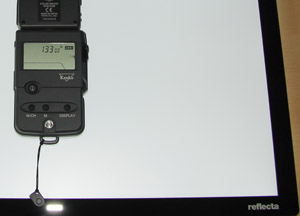
Just as the other light tables by Reflecta from the A3/A4/A5 series, the light of the light table A3 is extremely cold. Since Reflecta does not state any value in its test results, we measured ourselves and found the value to be 13000 K - which is incredibly low. The light table has a pleasant size to judge lots of slides and entire film envelopes, but due to the extremely cold light, it is not well suited for judging the colors of film material. Photographic film material should be judged at a color temperature of 5000 K. Hence the reflecta LED light table A3 is perfectly suited for sorting film material and making selections from a variety of images. For evaluation of colors, it is not well suited.
Light panel reflecta L1400 LED
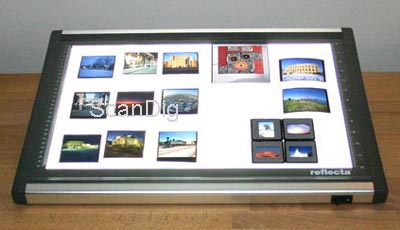
Anyone who professionally often has to deal with film material or, as a private person, spends whole weekends or even a whole retirement ranging and viewing slides will need a large light panel such as the reflecta L1400 LED. Its overall dimensions are 550 x 405 x 30 mm, the weight is 4.3 kg. The size of the viewing area is 46 x 30.5 cm, which is equivalent to a surface of 1,400 square cm - therefore the designation L1400.
The light panel Reflecta L1400 LED has been taken from the market in 2016.
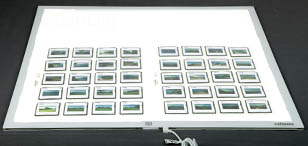
This seemingly endlessly large viewing area offers a lot of space for film material of any kind: 54 mounted 35mm-format slides, 35 medium format slides of 6 x 6 cm or up to 12 large format slides in 4 x 5" size can be viewed at one time. For photographers or agencies who range their image collection in A4-size (21 x 29,7 cm) sheet protectors, another feature, however, will be decisive for the purchase: the height of the illuminated area corresponds quite exactly to an A4-sheet's height. Thus, with a width of 46 cm, two DIN A4 sheet protectors can be placed next to each other onto the viewing surface without having to take out the individual slides. This saves a lot of time when looking for single images in a large collection that one intends e.g. to scan in or to pass on.
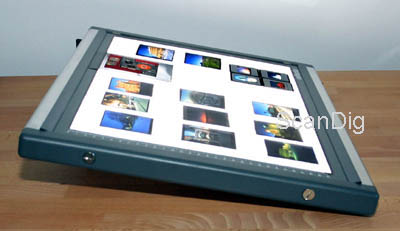
On its rear side, this light panel is equipped with an integrated lifting frame; as soon as this is opened, the light panel is set to an angle that is convenient for working at it. In order to prevent the slides from slipping away, there are fixation bars on the upper and lower edge of the viewing area where sheet protectors or single slides can be inserted. This works easily and reliably for sheet protectors, but for single positives or film strips, these bars are positioned too far away from the viewing area itself.
Smooth illumination of the large viewing area is provided by modern LED lamps. These lamps, having a durability of approx. 10,000 hours according to the manufacturer, produce standard light with a colour temperature of approx. 5,000K. The viewing area is also evenly lit in the corners, thus making it possible to use every single square centimetre for the viewing of positives. I could not detect a significant heating up of the illuminated area even after 8 hours of use. This avoids the deformation or curling up of film material because of warmth.
It is obvious that a light panel with a width of more than half a metre and a weight of more than 4 kg is intended for stationary use on a desk; battery operation is not possible. Transport can best be done in the cardboard box it is originally delivered in. A convenient leather bag as reflecta delivers along with their smaller light panel series is, unfortunately, not available for the L1400. On the other hand, anyone mounting this light panel on a wall (the necessary items are included) will not transport it any more anyway.
Finally, I want to mention a centimetre scale on the left hand side of the viewing area and an inch scale on its right - they come in handy to measure the size of an image detail or the film size of a large format film. And, last, I would like to commend the good design: a combination of stainless steel and dark grey plastic material gives a valuable aspect to the case; thanks to its thickness of only 30 mm, this large light panel fits very well in a modern working environment.
Addendum: The same model is available in a larger version, Reflecta Light Panel L1800 LED. While the light panel of the described model L1400 is of 1400 cm², the larger model L1800 has a light surface of 1800 cm²; the exact measurements of the light panel are 610 x 305 mm. Both light panels have the same equipment components.
Big light panel Kaiser slimlite LED 61 x 35,5 cm
For those who still consider the already remarkable light surfaces of the light panels L1400 and L1800 (see previous chapter Reflecta L1400) of Reflecta to be much too small, the firm Kaiser Fototechnik offers a special highlight: The light panel "slimlite" with the measures 61 x 35,5 cm has a light surface of almost 2200 cm², this is again more than 300 cm² than in case of the Reflecta L1800 and therewith the biggest light panel for the field of photography I know.
The Kaiser light panel slimlite LED 61 x 35,5 cm has been taken from the market in 2016.
Despite of this huge surface, Kaiser achieved to make the high-quality case to be very compact. The external measurements are of 70 x 45 cm, the thickness of 3 cm is, as the name already says, very thin. But anyway, the slimlite LED 61 x 35,5 cm is of course mainly suitable for the steady state operation, as it actually also weights more than 7 kg.
This light panel is the first choice specially for agencies, photographers and private users with some huge picture libraries, specially if the slides and negatives are kept inside the frequently used sheet protectors in the format DIN A4 (29 x 21,7 cm). Two of those fit on the light surface beside each other without any problem.
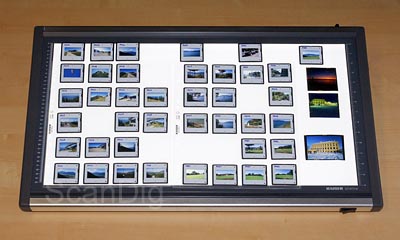
But more than that, there is still enough space to position the selected images at the sides or above the sheet protectors so that they are still on the light screen. In order to avoid that the protection sheets move, there are some practical frames for insertion fixed at the upper and the lower edge of the light surface; unfortunately, these frames are much too far positioned from the light surface for the straight fixing of the film material.
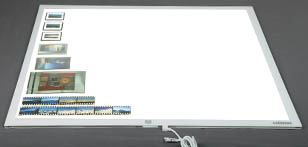
For those who sort their slides in magazines and want to scan them afterwards, the Kaiser "slimlite" LED 61 x 65,5 cm will provide a useful service. With more than 80 framed 35-mm slides, almost a complete classic slide magazine of 100 can be exposed on the light panel for the selection of the best ones to be scanned! And also large amounts of the medium and large format images have some space on the light surface: It is possible to view up to 60 images of a format of 6x6 and up to 18 large formats of 9x12 at the same time. Therewith, the sorting out and the selecting if images is great fun !
Despite of the huge size, the light surface is very uniformly illuminated, also in the corners. This is provided by powerful LEDs and a special technique of branch circuit and reflection. Both lamps provide a standardized daylight of 5000 kelvin and even after several hours of operation there is no heat development noticeable.
It is self evident that with such a lamp performance no battery operation is posible. The electricity supply takes place over a 24V power supply unit that is included in the scope of delivery. Kaiser slimlite LED 61 x 65,5 cm has a solid foldout lifting frame at the bottom side in order to make the work easier and also for the better viewing of the upper slides. What outstands very positively is that despite of the resulting sloping position, neither the frames slides nor the lose film material do not slip on the light surface. Additionally, it is also possible to mount it on the wall, the respective fixtures are available at the back side, and for fixing for example radiographs there are the already mentioned insertion frames. A centimetre scale on the left and an inch scale at the right side of the light surface round the professional appearance of the Kaiser light panel slimlite LED 61 x 35,5 m.
Thus, the biggest Kaiser-light panel slimlite LED 61x35,5 cm is clearly recommended by us for photographers who need to view and sort a large amount of images in the same time. Due to its huge size, the practical and fast arrangement and the possibility to mount it on the wall, this light panel is also suitable in the medical field for the viewing of radiographs.
Dörr light table LT-6060 LED (illuminated area of 55.5 x 55.5 cm)
With its illumited area of 3080 cm², the Dörr light table LT-6060 LED is one of the biggest stepless dimmeable light tables in ultra flat design on the market. Despite the enourmous outer diameters of 59 x 59 x 0,8 cm, it weighs less than 3 kilograms. To be precise, 2895 grams. The light table comes in all white and is cased by a 3.5 cm border, leaving a quadratic illuminated area of 55.5 x 55.5 centimeters.
We have removed the Dörr light table LT-6060 LED from our portfolio in 2019.
The mains adaptor (AC100-240V~ 50/60Hz DC12V 2A) comes in all white, too, providing energy to the light table. Battery operation is not an option. The mains plug is a micro usb port. It is clearly labeled not to be used with cell phones or tablets. In the scope of delivery, you will also find a black slipcover with a drawcord. This will protect the high quality acrylic surface during transport and storage.
Between the acrylic plates, a total of 114 LEDs are working with a very low 0,2 watts each, adding up to a total of 22,8 watts. Keeping in mind that 22,8 watts of LED light correlate to far more than 100 watts of light bulbs, this light table can easily illuminate an entire room if the brightness is set to maximum. The manufacturer specifies both color rendering index and color temperature. The color rendering index CRI is > 90 and the color temperature is 5600K. To evaluate slides in terms of color, one typically needs daylight, which is 5000K.
Via the on-off switch located in the middle of the light table, the device can be steplessly dimmed, depending on the purpose. According to the manufacturer, the light table is suitable not only for viewing slides and negatives, drawing and tracing, but also as a background light source for paper prints. Thanks to the sheer size of the device, this sounds like a viable option. With the dimmer set to maximum, the light table will turn into a very bright LED light source, which can easily illuminate a small room.
Thanks to the size of 55.5 x 55.5 centimeters, the illuminated area provides lots of space not only for film material of various sizes, but even for x-ray images, MRT/CT images and the likes. With two slide cassettes fit back to back, or two filing sheets, there is still plenty of extra room. On the downside, of course, this light table eats up lots of space on the writing desk; thanks to its low thickness, it can be comfortably stored in its cover after use and placed vertically next to the writing desk.
Slide viewer reflecta B250
The reflecta B250 slide viewer is a mixture between a slide viewer and a light panel. The B 250 has a viewing area of 230 x 65 mm. Thus, this viewing area offers place for four mounted 35mm-format slides next to each other or a typical medium format film strip with a lenth of 20 cm that consists of 3 6 x 6 images.
The slide viewer reflecta B250 has been taken from the market in 2014.
But the B250 is more than a miniature light panel: the viewing area can be closed with a lid, safely protecting the glass panel during transport. During operation, one brings the lid into a vertical position and places a sliding magnifier on it. This magnifier offers a magnification of the image below it by the factor 2, thus enabling the viewer to recognize more details. This magnifier works impeccably, one easily forgets that a magnifier is used when looking at a slide. The magnifier covers an area of about 6 x 7 cms; in the case of larger medium formats, the magnifier can easily be moved on its guide rail.
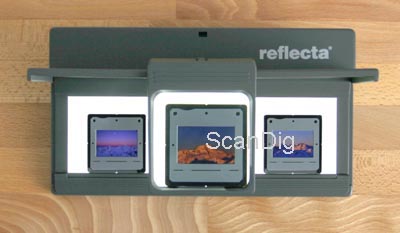
Without a mounted magnifier, the B250 is a standard small light panel with a cold cathode fluorescent lamp producing light of a temperature of 5,000 K and distributing it evenly to the whole viewing area, thus permitting to use every square centimetre for viewing slides. Thanks to two lifting brackets on its lower side, the light panel can be set to an angle, which allows a convenient viewing angle. To prevent the slides that are placed onto it from slipping, an edge of approx. 2 mm has been put on the lower edge of the viewing areawithout a distance between them. One can conveniently place mounted slides or film strips on this edge, which assures a good hold during operation.
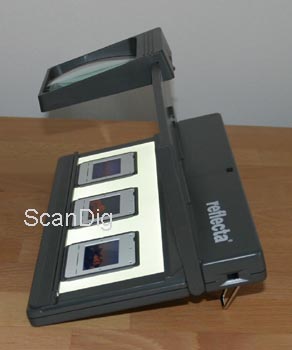
This positioning edge is, however, not only of use for the fixation of film material; it also includes a revolving lid that allows a reduction of the viewing area to a height of exactly 5 cm. In this operation mode, the illuminated area is perfectly adjusted to mounted 35mm-format slides that exactly fit in between the upper and lower guide rails, are kept in a horizontal position all the time and can not slip away - a really good design! If one wishes to view a larger series of slides, e.g. the content of a whole magazine to select images to scan or not, image by image can be inserted on the left hand side between the guide rails and taken out on the right hand side. This is convenient and permits to do a sort of small-scale assembly line work.
The B250 slide viewer operates on six AA-type batteries or rechargeable batteries that are not included in delivery. Using heavy duty rechargeable batteries, operation up to 10 hours is possible. An optional accessory for the B250 slide viewer is a 9V mains adaptor allowing permanent use. Thanks to the cold light lamp, the light panel does not heat up during operation.
Standard delivery also includes a pouch into which the device easily fits, which allows secure transport without a lot of effort. When closed, the light panel has overall dimensions of 260 x 144 x 20 mm and can thus be called "ultra-flat" as well as optically appealing. As its weight is only 630 grs, transport in its bag with handles is easily possible.
Back to the index hardware tests
|


 Batteries and chargers